
The British curriculum stages take children from the Foundation Stage through primary and secondary education to Year 13. Each phase builds on earlier learning, moving from play and early language skills towards subject choices and university preparation.
For parents in the UAE, understanding the stages also helps answer practical questions: which year should your child join, how does each year compare with a grade-based system, and what changes at the next stage?
How Are the British Curriculum Stages Organised?
The British curriculum used in UAE schools is based on the National Curriculum for England. Many British schools in the UAE organise the British curriculum stages as England does: the Early Years Foundation Stage (EYFS), Key Stages 1–4 (KS1–KS4) and post-16 study in Years 12 and 13. Primary education covers Years 1–6; secondary education begins in Year 7.
When comparing British curriculum schools in UAE, check which stages each school offers. Some provide the full journey, while others serve specific age groups, so families may need to plan a move between schools.
British Curriculum FS to Year 13: Year Groups and Grades
The table below compares British curriculum year groups with typical ages and common UAE equivalents. These British curriculum grade levels are a guide; admission cut-offs and previous schooling affect individual placement.
| British year group | Typical age | Stage | Common grade equivalent |
|---|---|---|---|
| FS1 | 3–4 | EYFS | Pre-KG |
| FS2 | 4–5 | EYFS | KG1 |
| Year 1 | 5–6 | KS1 | KG2 |
| Year 2 | 6–7 | KS1 | Grade 1 |
| Year 3 | 7–8 | KS2 | Grade 2 |
| Year 4 | 8–9 | KS2 | Grade 3 |
| Year 5 | 9–10 | KS2 | Grade 4 |
| Year 6 | 10–11 | KS2 | Grade 5 |
| Year 7 | 11–12 | KS3 | Grade 6 |
| Year 8 | 12–13 | KS3 | Grade 7 |
| Year 9 | 13–14 | KS3 | Grade 8 |
| Year 10 | 14–15 | KS4 | Grade 9 |
| Year 11 | 15–16 | KS4 | Grade 10 |
| Year 12 | 16–17 | Post-16 | Grade 11 |
| Year 13 | 17–18 | Post-16 | Grade 12 |
From Year 2 onwards, subtract one from the year number for a quick British year to grade comparison. Year 11 therefore corresponds to Grade 10. This compares year labels; it does not mean that different curricula teach identical content.
Key Stages British Curriculum Schools Follow
Early Years (EYFS): FS1 and FS2
The EYFS develops the communication, physical and social skills children need for school. In the UAE, its two years are usually called FS1 and FS2; FS2 corresponds to Reception in England.
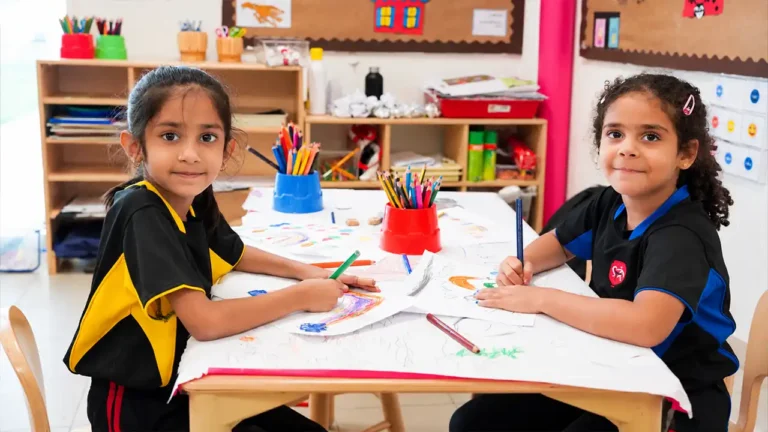
Children learn through play, stories, conversation and guided activities. Seven areas underpin learning: communication and language; personal, social and emotional development; physical development; literacy; mathematics; understanding the world; and expressive arts and design.
Building a tower, for example, involves counting, balancing and cooperating. Teachers observe everyday activities to understand progress. Early Explorers Nursery in Sharjah also places play-based learning at the centre of its approach.
For new admissions in 2026–2027, children entering FS1 at UAE schools whose academic year begins in August or September must turn three by 31 December 2026. Some eligible children will therefore still be two when term starts. Our guide to the FS1 age in UAE explains the cut off for every early year group.
Pupils already enrolled continue under the admission rules in place.
Key Stage 1: Years 1 and 2
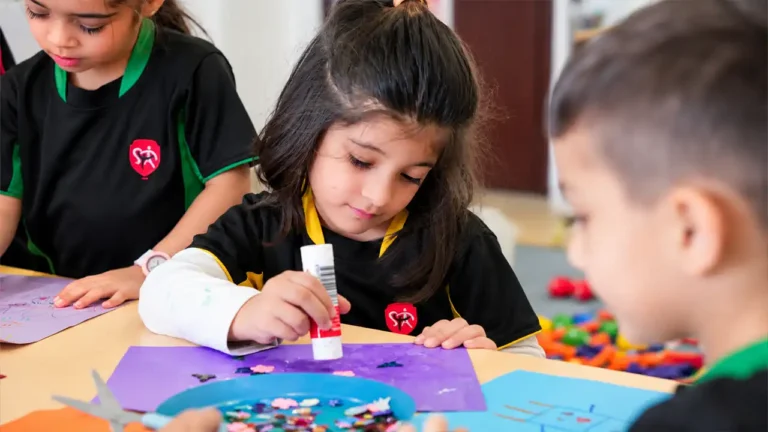
This stage typically covers ages five to seven. Children begin more structured lessons while continuing to learn through practical activities.
Phonics supports early reading, writing develops from words into sentences, and mathematics builds understanding of numbers, calculation and shapes. Science encourages children to observe and ask questions.
England’s national curriculum identifies English, mathematics and science as its three core subjects. Art, computing, history, geography, music and physical education broaden learning.
Parents researching the best primary schools in Dubai should ask how teachers support different reading levels and help children settle into classroom routines.
Key Stage 2: Years 3 to 6
This stage typically covers ages seven to eleven. Pupils use their growing knowledge to explain ideas and tackle more demanding tasks.
In English, they interpret texts and organise longer writing. Mathematics develops calculation, fractions and problem-solving. Science involves carrying out investigations and explaining findings.
Teaching approaches also matter. Scholars International Academy uses High Performance Learning to develop students’ thinking skills alongside academic knowledge.
By Year 6, preparation for secondary school becomes important. Ask how the school helps children organise belongings, manage assignments and become comfortable asking different teachers for help.
Key Stage 3: Years 7 to 9
This is the first phase of secondary education, usually for ages eleven to fourteen.
Students deepen their knowledge across English, mathematics, science, humanities, languages, computing, arts and physical education. Learning usually involves more subject teachers and greater responsibility for preparation and deadlines.
These years help students discover their interests before they choose examination subjects; enjoyment matters alongside results and possible future course requirements.
When comparing the best secondary schools in Dubai, look at subject breadth, pastoral support and how teachers guide students towards suitable options.
Key Stage 4: Years 10 and 11
This stage usually covers ages fourteen to sixteen and leads to GCSE or IGCSE qualifications. Cambridge IGCSE is designed as a two-year course, although delivery can vary.
Students combine required subjects with school options. Reviewing available IGCSE subjects helps families understand the choices before selecting a programme.
Check the examination board and assessment format. Written papers, practical assessments, speaking tests or coursework may feature, depending on the qualification.
Students should consider:
- which subjects they enjoy and perform well in
- what later A Level courses require
- whether their preferred combinations fit the school timetable
GCSE and IGCSE are qualifications at this stage; they are not additional year groups.
Sixth Form: Years 12 and 13
Often called Key Stage 5 or post-16, this is the last of the British curriculum stages and usually covers ages sixteen to eighteen. Students narrow their choices and study in greater depth, with more independent work such as wider reading, research and longer assignments.
Understanding the difference between IGCSE and A Level helps families prepare for this increased specialisation.
Cambridge International A Levels typically take two years, while AS Levels usually take one. Whether AS results contribute to a full A Level depends on the qualification structure.
Students should check university requirements before choosing subjects, because entry requirements may specify particular subjects as well as grades.
Families considering Dubai Scholars Private School, which provides education through Year 13, can ask about its current post-16 subjects and entry requirements.
Moving Between Schools or Curricula
For transfers in the UAE, placement considers the last successfully completed grade and academic progression under approved equivalency procedures. An age table alone cannot confirm the correct year group.
Share school reports and discuss differences in subject content, language support and assessment. During GCSE, IGCSE or A Level courses, ask whether the receiving school uses the same examination board and syllabus.
Also check how progress is measured. England’s national assessment arrangements should not be assumed to apply identically in every British school overseas.
If you are considering a place at a Scholars International Group school, Apply Online and ask the admissions team which year group and next steps suit your child.
Frequently Asked Questions
1. What are the 4 core subjects in the British curriculum?
There are three official core subjects in England’s national curriculum: English, mathematics and science. Some schools list English Language and English Literature separately or require additional subjects, which can create the impression that there are four.
2. Which British curriculum year is equivalent to Grade 10?
Year 11 generally corresponds to Grade 10 in the common UAE comparison. Students are typically fifteen to sixteen years old and usually complete GCSE or IGCSE examinations during this year.
3. At what age do children start FS1 in British schools in the UAE?
Children can start FS1 at age three. For new admissions in 2026–2027 at schools whose academic year starts in August or September, a child must turn three by 31 December 2026, so some begin FS1 while still two.